Drugs of the Dreaming by Gianluca Toro
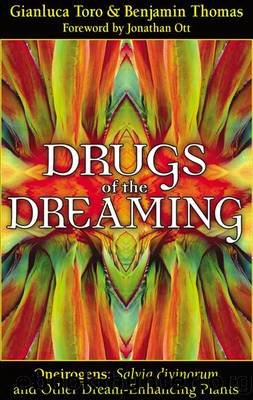
Author:Gianluca Toro [Gianluca Toro and Benjamin Thomas]
Language: eng
Format: epub
Publisher: Inner Traditions/Bear & Company
Published: 2011-05-12T00:00:00+00:00
5
Oneiromagicals
Oneirogens in Ancient and Modern Magic
Magic could be intended as a way to modify the world in order to follow a precise purpose, a secret knowledge. Every human culture in the world performed (and performs) magic actions by means of proper rituals and tools; magic is activated by rituals and directed by tools. Plants are one of the most important tools. They can be plants of prophecy, magical medicines, and ingredients in elixirs of immortality, aphrodisiacs, poisons, and death charms. They are used in mysteries, libations, ritual circles, vision quests, incantations, oracles, sacrifices, hunting magic, and eroticism. The anthropological research has demonstrated that magical plants are generally psychoactive.
This chapter deals with a selection of plants and preparations used in the context of magical beliefs, in ancient and modern times, comprising species to which somewhat controlled references and more or less reliable witnesses attribute oneirogenic properties.1
These plants are employed in ointments, pills, infusions, burners, or as âdream pillows.â A dream pillow is stuffed with aromatic herbs and then tucked under the head; as a sleeping person tosses and turns restlessly, the herbs are crushed to exude their scent.
Kyphi
Surely the most renowned and legendary perfume produced in ancient Egypt was kyphi. Its use can be traced back at least to the sixteenth century BCE in a ceremonial religious context under the control of praying priests.
There were many preparations of kyphi, and the number of ingredients was variable. The original recipe is reproduced on the walls of the Egyptian temple of Edfu (third to first century BCE) consecrated to the god Horus. Another recipe is reported in the Papyrus Ebers. Maneton, an Egyptian priest and writer of the third century BCE, wrote a book titled About the Preparation of Kyphis. It is believed that Plutarch (first century CE) derived the ingredients from Maneton and presented the recipe in De Iside et Osiride. A recipe for kyphi is also reported by Dioscorides (first century CE) in his Materia Medica.
Kyphi was induced via fumigation, ingestion, and perhaps as an ointment. It had many uses. It could create a dreamy state of happiness, aid communication with the gods, and uplift the spirit. Plutarch states that under the influence of kyphi the body has a propitious disposition to sleep. The perfume purifies the imaginative and oneiric faculty. Kyphi also had medicinal properties; it was used in curing lung diseases, asthma, liver disorders, for the purification of intestines, and other ailments.
A list of ingredients found in one kyphi recipe includes aspalathos, bitumen, cardamom, cinnamon, cyperus, fenugreek, frankincense, honey, juniper, lentisk, mastic, mint, myrrh, olibanum, pistacia resin, raisins, rumex, rush, seseli, thornapple, styrax juice, sweet flag, and wine.
Rush is the translation of the Greek term thryon and refers to plants of the genus Juncus. These plants can sometimes be infested by parasitic mushrooms of the Clavicipitaceae family producing ergot alkaloids. Among species of Juncus, Dioscorides reports one called eyripike schoinos. Its seeds induce sleep and also lethargy. Pliny reports two species of Juncus called holoschoenus and euripicen. Holoschoenus causes headaches, and euripicen induces sleep and lethargy if used in excessive doses.
Download
This site does not store any files on its server. We only index and link to content provided by other sites. Please contact the content providers to delete copyright contents if any and email us, we'll remove relevant links or contents immediately.
Becoming Supernatural by Dr. Joe Dispenza(8223)
Crystal Healing for Women by Mariah K. Lyons(7933)
The Witchcraft of Salem Village by Shirley Jackson(7277)
Inner Engineering: A Yogi's Guide to Joy by Sadhguru(6798)
The Four Agreements by Don Miguel Ruiz(6767)
The Power of Now: A Guide to Spiritual Enlightenment by Eckhart Tolle(5788)
Secrets of Antigravity Propulsion: Tesla, UFOs, and Classified Aerospace Technology by Ph.D. Paul A. Laviolette(5373)
The Wisdom of Sundays by Oprah Winfrey(5165)
Room 212 by Kate Stewart(5129)
Pale Blue Dot by Carl Sagan(5012)
Fear by Osho(4741)
The David Icke Guide to the Global Conspiracy (and how to end it) by David Icke(4721)
Animal Frequency by Melissa Alvarez(4475)
Rising Strong by Brene Brown(4465)
How to Change Your Mind by Michael Pollan(4358)
Sigil Witchery by Laura Tempest Zakroff(4248)
Man and His Symbols by Carl Gustav Jung(4138)
The Art of Happiness by The Dalai Lama(4132)
Real Magic by Dean Radin PhD(4131)
